Metal Roofing Buying Guide: Facts, Myths, Installed Prices, FAQs

If you are looking to replace that old asphalt roof on your home with a metal roof this Spring, Summer or Fall, but still have a few lingering questions or concerns, then here are the top 70 metal roofing facts, myth-busters, FAQ, plus an overview of costs and pros and cons to consider before making your buying decision.

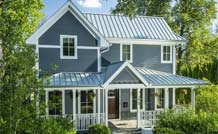
A Rustic House with a Multi-Level Standing Seam Metal Roof Designed to Shed Ice and Snow Build-up

via Birdseye Design

Did you know? A metal roof can be a sensible way to protect your home, especially if you happen to live in an area that experiences a lot of storms, rapid temperature changes, beaming sun that melts asphalt, large hail, or heavy snowfall. — Just ask any homeowner in Florida, Oklahoma, Arizona, Texas, Illinois, Ohio, upstate New York, Northern New Hampshire, Maine, Vermont, and they will readily attest to this! 😉
New Shingle Roof

$7,500
Average price
New Metal Roof

$14,500
Average price
New Flat Roof

$8,225
Average price

See costs in your area Enter Your Zip Code

To help you navigate this long list, we broke it down into the following categories:

Materials Pros & Cons Standing Seam Metal Roof Galvalume Color

Cost of Materials
Installation
Cost of Installation
Colors & Styles
Longevity
Weather Protection
Durability
Maintenance
Energy Efficiency
Environmental Impact
ROI
10 Bonus Facts

Metal Roofing Materials Pros & Cons:

  • standing-seam Metal roofs can be made from a variety of metals and alloys including
    — Galvanized G-90 steel (hot-dip zinc galvanized high-end steel), and G-60 steel (a less expensive, thinner-gauge steel, often used in low-end, lower-cost corrugated and ribbed metal panels)
    Galvalume steel (zinc and aluminum coated steel) has a more expensive and longer-lasting coating compared to G-90 galvanized steel.
    — stone-coated steel (G-90 galvanized steel), aluminum, copper, zinc, terne (zinc-tin alloy), and stainless steel.
  • The downside of galvanized steel (G-90, and especially G-60) is that it can corrode, eventually, especially when exposed to moist, salt-spray environment such as when your home is situated near the ocean or near the coastal areas.
  • Steel is the most frequently used material in both residential and commercial applications, mainly due to its lower cost.
  • Aluminum is the second most popular material. It is more durable and longer lasting than steel, but only costs a fraction of the price of premium metals, such as copper or zinc.
  • Aluminum is also one of the best metals to use for roofs located in coastal areas (think those beach homes), where there is a heavy presence of salt spray in the environment.
  • Copper roofs are the most durable and can last for hundreds of years. However, due to prohibitively high cost, few people choose to install an entire roof made from copper. Instead, home and business-owners choose copper for architectural details/accents on the roof (bay windows, towers, porches, low slope roof sections, Etc.).

copper standing seam bay windows

Read more

Metal Roof vs Asphalt Shingles Cost – Is a Metal Roof Worth It?

When comparing the cost of metal roofing vs. shingles, there are a few factors to consider. Here is an in-depth look at the cost comparison between the two roofing materials:

    1. Initial Cost: The initial cost of metal roofing is generally higher than that of shingles. Our research shows the average cost to install a new metal roof is between $11.50 and $20.50 per square foot, depending on the type of metal and project specifics, while asphalt shingles typically cost between $4.50 and $9.50 per square foot.
New Shingle Roof

$7,500
Average price
New Metal Roof

$14,500
Average price
New Flat Roof

$8,225
Average price

See costs in your area Enter Your Zip Code

  1. Long-term Cost: Although metal roofing is more expensive initially, it can be more cost-effective over the long-term. Metal roofing is more durable than shingles and can last 30 to 60 years, while shingles typically last 15 to 30 years. This means that you may need to replace shingles multiple times over the lifespan of a metal roof, increasing the long-term cost of shingles.
  2. Energy Efficiency: Metal roofing is generally far more energy-efficient than shingles. Metal reflects solar radiant heat, which can reduce the amount of heat absorbed into your home and lower your energy bills. Look for CRRC colors with a Kynar 500 paint finish to maximize energy savings with a metal roof. Additionally, some metal roofing systems can be installed with insulation to further increase  your home’s energy efficiency.
  3. Maintenance: Metal roofing is very low-maintenance and requires little upkeep over its lifespan. Shingles, on the other hand, can be prone to damage from storm winds, wind driven rain, ice dams, moss and mildew growth, and other weather conditions, and may require more frequent maintenance and repair.
  4. Resale Value: In the short run, an asphalt roof can offer better cost-to-value return than metal. In the long run, though, a metal roof will maintain its value for decades, whereas an asphalt roof will not. So, 10-15 years down the road, an asphalt roof may offer very little in terms of retained value and may be viewed more as a liability by potential buyers.

While the initial cost of metal roofing is higher than that of shingles, it can be more cost-effective over the long-term due to its durability, longevity, and energy efficiency. Additionally, metal roofing can add lasting value to your home and increase its resale value, maintaining it for decades to come.

Read more

Roofing Materials & Installation Costs: Shingles, Metal, Flat Roofs

Are you exploring the most suitable roofing options for your home? If so, roofing material types and their costs must be top of mind.

Need a Roofer? Get 4 Free Quotes From Local Pros:

Enter Your Zip Code:

This guide will help you explore the most popular residential roofing materials, including pricing and installation costs.

Roofing Materials Costs

Asphalt Shingles:

Dimensional shingles roof on a house

Asphalt shingles are generally less expensive than other roofing materials like metal and are relatively easy to install (unlike metal roofing), resulting in a lower overall cost for a new asphalt roof. However, premium (designer) asphalt shingles, such as those from GAF, CertainTeed, and Malarkey, can be as expensive as high-end roofing materials like metal. Here’s a breakdown of different types of asphalt shingles:

3-tab shingles (strip shingles):

  • Materials Cost: $90 to $120 per square (100 sq. ft.), excluding trim.
  • Characteristics: Least costly, thin, not designed for longevity, flat appearance without much dimensionality.
  • Top Products: GAF Royal Sovereign, CertainTeed XT 25, Owens Corning Supreme.
  • Wind Rating: Up to 60 MPH.
  • Installation Note: Care needed for alignment to avoid vertical lines running off.
  • Disadvantage: No manufacturer’s warranty for hail damage.
  • Expected Lifespan: 10 years to 20 years, depending on local climate and roof maintenance.

Architectural (dimensional) shingles:

  • Materials Cost: $100 to $150 per square (100 sq. ft.), excluding trim.
  • Characteristics: Midrange, multiple layers, dimensional appearance, thicker, and sturdier.
  • Wind Rating: At least 110 MPH, up to 130 MPH with the 6-nails per shingle installation.
  • Top Products: Owens Corning Duration, GAF Timberline HDZ, CertainTeed Landmark
  • Specialty: CoolRoof rated shingles eligible for rebates in California.
  • Disadvantage: No manufacturer’s warranty for hail damage.
  • Expected Lifespan: 15 years to 25 years, depending on local climate and roof maintenance.

Premium (designer) shingles:

  • Materials Cost: $200 to $400 per square (100 sq. ft.).
  • Characteristics: Custom-looking, multiple layers, distinctive appearance, performance on par with high-end architectural shingles.
  • Top Products: CertainTeed Grand Manor, Owens Corning Berkshire, GAF Camelot, Malarkey Windsor.
  • Disadvantage: No manufacturer’s warranty for hail damage.
  • Expected Lifespan: 20 years to 35 years, depending on local climate and roof maintenance.

Read more