Asphalt Shingles Prices at Lowe’s & Home Depot: GAF, OC, Onduvilla 3D

How to Select the Best Type of Asphalt Shingles for your DIY Project when shopping at your local Home Depot or Lowe’s home improvement store, or Online:

OC TruDefinition Duration Driftwood shingle bundles for sale at Lowe’s

Need a Roofer? Get 4 Free Quotes From Local Pros:

Enter Your Zip Code:

We’ll save you the trip to each store (and gas) by providing the following details: Retail Cost per bundle and square (100 sq.ft.) of shingles, Best options for DIY roofing projects, and overview of each product/brand

Before we get into the details of how to select the best type of roofing shingles, let’s first discuss the general roofing shingle options that home improvement stores like Lowe’s and Home Depot have to offer.

Both chains offer roofing products from the most popular roofing brand and the number one seller of asphalt shingles in America, GAF.

With Home Depot, GAF products represent about 80% of all asphalt shingle products available through the stores and online. Home Depot’s other roofing shingle option is the Onduvilla brand, which is available for online purchasing.

With Lowe’s, GAF shingles are roughly 50% of their overall offerings for asphalt shingles. Lowe’s also carries Owens Corning roofing products, which is another popular brand comprising another half of roofing shingles available for sale in Lowe’s stores and online.

The Onduvilla shingles are not the typical kind of shingles. Onduvilla specializes in what is known as 3D shingles, which have a wavy pattern and can be used as a stand-alone type shingle (like the popular types) but is more or less geared toward building owners with a metal roof that might benefit from this as an additional layer of roofing.

Because of how atypical this product is, we won’t be including it as part of the selection process, but we did want to mention it as a high-end and a fairly unique roofing option. The Onduvilla shingles cost about $50 per bundle (20 sq.ft.) or $250 per square, with 10 pieces in each bundle.
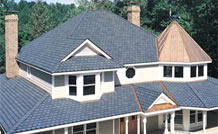
New Shingle Roof

$7,500
Average price
New Metal Roof

$14,500
Average price
New Flat Roof

$8,225
Average price

See costs in your area Enter Your Zip Code

Both Lowe’s and Home Depot stores provide all the roofing accessories including underlayments and Ice-and-Water shields, ridge caps, and vents, to make for a complete roofing system.

Below, we list the costs for each option, along with the required components. We won’t provide costs for flashing as that varies in purpose, and it’s therefore best to discuss with either a professional contractor or store specialist to make sure you are obtaining the most suitable product for the job.

Note: in many cases, prices on the products are almost exactly the same between the two stores. However, when this is not the case, we are providing the lowest cost from either store, and if there is significant difference, we’ll let you know.

Leak barrier / Underlayment material

  • GAF WeatherWatch Leak Barrier (aka Underlayment) = $49.50 for 150 sq.ft. roll
  • Grace Roll Roofing Underlayment = $138.00 for 225 sq.ft. roll

Starter Shingles

  • GAF Pro-Start Black Starter Shingles = $36.90 for 120 linear feet
  • Owens Corning Starter Shingles Black = $22.60 for 100 linear feet (through Lowe’s)

Ridge Vent

  • GAF Cobra Ridge Low Profile Exhaust Vent = $49.00 for 20 ft. roll
  • GAF Cobra 3 (Plastic) Ridge Exhaust Vent = $82.30 for 4 ft. piece
  • Owens Corning VentSure Plastic Roll Ridge Vent = $60.10 for 20 ft. roll

Read more

Roof Financing – How to Pay for a New Roof – The Ultimate Guide

When the time comes, replacing your roof is a big, important, investment. Since a new roof can cost $10,000 or more, paying cash is not an option for most homeowners. Financing, by taking out a home equity line of credit or a home improvement loan, is how most homeowners pay for the roof they need.

A new asphalt shingle roof with PV solar panels
New Shingle Roof

$7,500
Average price
New Metal Roof

$14,500
Average price
New Flat Roof

$8,225
Average price

See costs in your area Enter Your Zip Code

A line of credit or a loan allows a homeowner to pay in installments spread out over time, which is easier to handle than an upfront cash payment in full. This guide will help you sort out the different types of home renovation loans so you can find the one that best meets your needs.

The first step is to contact at least three licensed contractors to discuss your roofing options and to get estimates on the cost of a new roof. Knowing how much your new roof will cost will help determine which type of financing works best for you.

Home Equity Lines of Credit (HELOCs)

HELOCs are revolving credit lines that typically come with variable interest rates. Your monthly payment amount will depend on the current interest rates and your loan balance.

HELOCs are very similar to credit cards, except the rates are generally significantly lower because your home serves as a collateral, whereas credit cards are considered a form of unsecured debt (with some of the debt often becoming uncollectable for Credit Card companies, hence requiring high interest rates) with much higher interest rates.

Once, you are approved for a certain HELOC amount, you can then draw any amount, at any time, up to your credit limit. You can pay the loan down or off at will.

HELOCs have two phases. During the draw period, you use the line of credit as needed, and your minimum payment may cover only the interest due for that month.

However, eventually, usually after ten years, the HELOCs draw period ends and your loan enters the repayment phase. At this point, you can no longer draw funds and the loan becomes fully amortized for the remaining years.

HELOCs offer low closing costs and are very convenient. They offer low monthly payments during the draw period. The downside of these loans is that they use variable interest rates, meaning the interest rate can rise in tandem with the Federal Reserve’s prime rate.

Also, your monthly payments can significantly increase once the repayment phase begins and you begin paying both the interest and the principle on the loan.

Homeowner’s Insurance Coverage

You might be able to use your homeowner’s insurance policy to cover the cost of a new roof. Many homeowners’ insurance policies also include roof replacement insurance, and hence will cover roof replacement if the roof was severely damaged by fire, wind, or hail. However, if your roof degraded due to age and general wear-and-tear and/or due to a lack of maintenance (no roof cleaning, allowing moss outgrowth, not dealing with issues like loose shingles in time, etc.), the insurance company won’t cover the replacement. One thing to consider is that making a claim on your insurance will, most likely, raise your premium in the future.

Read more

Natural Stone Siding Cost Vs. Stucco, Brick Veneer, and Metal Siding

The primary purpose of any siding material is to add a layer of protection and insulation to your home’s building envelope designed to shield the structure from weather elements.
With the above in mind, here are other important factors determining the best approach to a house siding project:

  • Whether you do it yourself or hire a professional
  • Total upfront cost of the siding job
  • Unique house styles and the importance of curb appeal

Let’s get started with the general breakdown of costs you can expect for the somewhat less well-known siding materials we cover in detail below:

Siding Type: Material: Labor: Total Cost per sq.ft.
Stucco $5.00 – $6.50 $3.50 – $8.50 $8.50 – $14.50
Brick & Brick Veneer $6.00 – $15.00 $6.50 – $10.00 $12.50 – $25.00
Natural Stone $17.50 – $33.00 $7.50 – $12.00 $25.00 – $45.00
Alum, Zinc, Steel, Copper $4.50 – $16.50 $5.50 – $8.50 $10.00 – $25.00

House Siding Materials You Probably Never Heard of!

Complete Breakdown of costs for Stucco, Brick and Brick Veneer, Natural Stone, and Metal Siding

Stucco

Some think of stucco as popular in certain regions like Southern California, without realizing there are likely stucco homes in their own neighborhood.

Image source: View-Master Home Inspections

Our view is that stucco is a viable, long-lasting and architecturally attractive material that complements other house siding options.

Made from sand, cement, lime and water, the material is usually applied to a galvanized steel screen, along with a waterproof underlayment glued to a wood frame.

The stucco material itself isn’t all that versatile and instead is rather quite rigid, requiring special care during the installation to avoid cracks. But given that it is a hard material, it will last for the lifetime of a home, or at least 50+ years.

Costs: for stucco siding can range from $8.50 to $14.50 per sq. ft. installed, depending on the quality of materials, who’s doing the work and location of the property.

An average-sized home with 2,000 sq.ft. of siding will cost between $17,000 and $28,000 for the installation of new traditional stucco siding, including the cost of materials, professional installation, and workmanship warranty.

Pros: Very durable, low maintenance, great insulator, colors go through mix so repainting not necessary, resistant to fire and insects

Cons: Fairly expensive, takes skill to install, brittle material prone to cracking especially due to settling of a house, a sinking foundation, or even a mild earthquake. Not a good option for wet climates, tends to last less time in climates with lots of rain.

If the stucco material becomes saturated with water due to constant dampness or gutter leaks, then its insulation properties will be compromised and structural damage to the house may ensue.

Read more