When you consider the total ownership cost of solar panels – materials, installation, financing, and maintenance – they are now a cheaper electricity source than fossil fuels. However, since sunlight is not always available, solar panels cannot deliver power continuously. To use energy from the sun at night and on cloudy days, you need a solar battery.
Solar panels coupled with Sonnencore battery for home energy storage via Sonnen USA
There are many types of energy storage systems, but batteries have many features that make them an ideal complement for solar panels. They are available in many sizes, ranging from compact home batteries to utility-scale systems that can power many buildings at once.
Solar roof shingles can be an attractive option for homeowners who don’t like the appearance of conventional solar panels. Unlike the traditional PV installations where panels are mounted on top of the roof, solar shingles and tiles become part of the roof itself.
Suntegra integrated solar tiles on a roof
As you might guess from the name, these are roof shingles with built-in photovoltaic cells, which means you don’t need to install two separate components. SunTegra is one of the leading solar tile roof providers in the US, and their products can easily integrate with both asphalt shingle and concrete tile roofs.
SunTegra was founded in 2013, and the company was originally called Integrated Solar Technology (IST). SunTegra was founded by Oliver Koehler, who had already accumulated 15 years of experience in the solar power industry.
As of 2024, SunTegra has expanded to Canada and Mexico, and the company offers two main products: solar shingles and solar tiles. Each product line has different dimensions and specifications, adapting to many different types of roofs.
SunTegra is also working on new solar products for gardens and patios, which will become available in the near future. They are also developing solar products for building facades and other vertical surfaces, which will also be available for commercial and community buildings.
Suntegra Solar Shingles and Solar Tiles: What Is the Difference?
If you visit the SunTegra website, you will notice they offer two main products: solar tiles and solar shingles. Each product is designed for different types of roofs, and below we will provide a detailed comparison.
Suntegra solar tiles on a concrete roof
Both SunTegra products use monocrystalline solar cells, achieving a rather high electricity output throughout their service life.
SunTegra Solar Tiles are designed for concrete or clay tile roofs, and they can be installed just like traditional concrete tiles. You can use them in a new construction project, or you can upgrade an existing concrete or clay tile roof without having to replace all the tiles. SunTegra solar tiles are suitable not only for homes, but also for commercial buildings and carports.
SunTegra Solar Shingles are designed to replace asphalt shingles, but they are also compatible with other low-profile roofing materials. They use 50% fewer parts than a traditional solar panel system, and they can also be installed twice as fast. SunTegra shingles have a lightweight design, and they have built-in wiring to speed up their installation.
The following table compares the features and specifications of both solar roof products from SunTegra. Keep in mind that they are designed for different types of roofs, and they are not competing products.
Both solar tiles and shingles can be used for partial upgrades, meaning you can go solar without having to worry about the expense associated with completely replacing the existing roof.
If you are looking to replace that old asphalt roof on your home with a metal roof this Spring, Summer or Fall, but still have a few lingering questions or concerns, then here are the top 70 metal roofing facts, myth-busters, FAQ, plus an overview of costs and pros and cons to consider before making your buying decision.
A Rustic House with a Multi-Level Standing Seam Metal Roof Designed to Shed Ice and Snow Build-up
Did you know? A metal roof can be a sensible way to protect your home, especially if you happen to live in an area that experiences a lot of storms, rapid temperature changes, beaming sun that melts asphalt, large hail, or heavy snowfall. — Just ask any homeowner in Florida, Oklahoma, Arizona, Texas, Illinois, Ohio, upstate New York, Northern New Hampshire, Maine, Vermont, and they will readily attest to this! 😉
New Shingle Roof
$7,500 Average price
New Metal Roof
$14,500 Average price
New Flat Roof
$8,225 Average price
See costs in your area
Enter Your Zip Code
To help you navigate this long list, we broke it down into the following categories:
Metal roofs can be made from a variety of metals and alloys including
— Galvanized G-90 steel (hot-dip zinc galvanized high-end steel), and G-60 steel (a less expensive, thinner-gauge steel, often used in low-end, lower-cost corrugated and ribbed metal panels)
— Galvalume steel (zinc and aluminum coated steel) has a more expensive and longer-lasting coating compared to G-90 galvanized steel.
— stone-coated steel (G-90 galvanized steel), aluminum, copper, zinc, terne (zinc-tin alloy), and stainless steel.
The downside of galvanized steel (G-90, and especially G-60) is that it can corrode, eventually, especially when exposed to moist, salt-spray environment such as when your home is situated near the ocean or near the coastal areas.
Steel is the most frequently used material in both residential and commercial applications, mainly due to its lower cost.
Aluminum is the second most popular material. It is more durable and longer lasting than steel, but only costs a fraction of the price of premium metals, such as copper or zinc.
Aluminum is also one of the best metals to use for roofs located in coastal areas (think those beach homes), where there is a heavy presence of salt spray in the environment.
Copper roofs are the most durable and can last for hundreds of years. However, due to prohibitively high cost, few people choose to install an entire roof made from copper. Instead, home and business-owners choose copper for architectural details/accents on the roof (bay windows, towers, porches, low slope roof sections, Etc.).


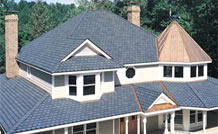 New Shingle Roof
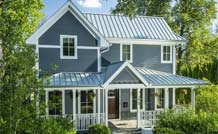 New Metal Roof
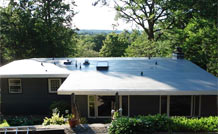 New Flat Roof
 See costs in your area


